
TORO Recovery Blog
How to Choose a Commercial Collection Agency or Collection Attorney.
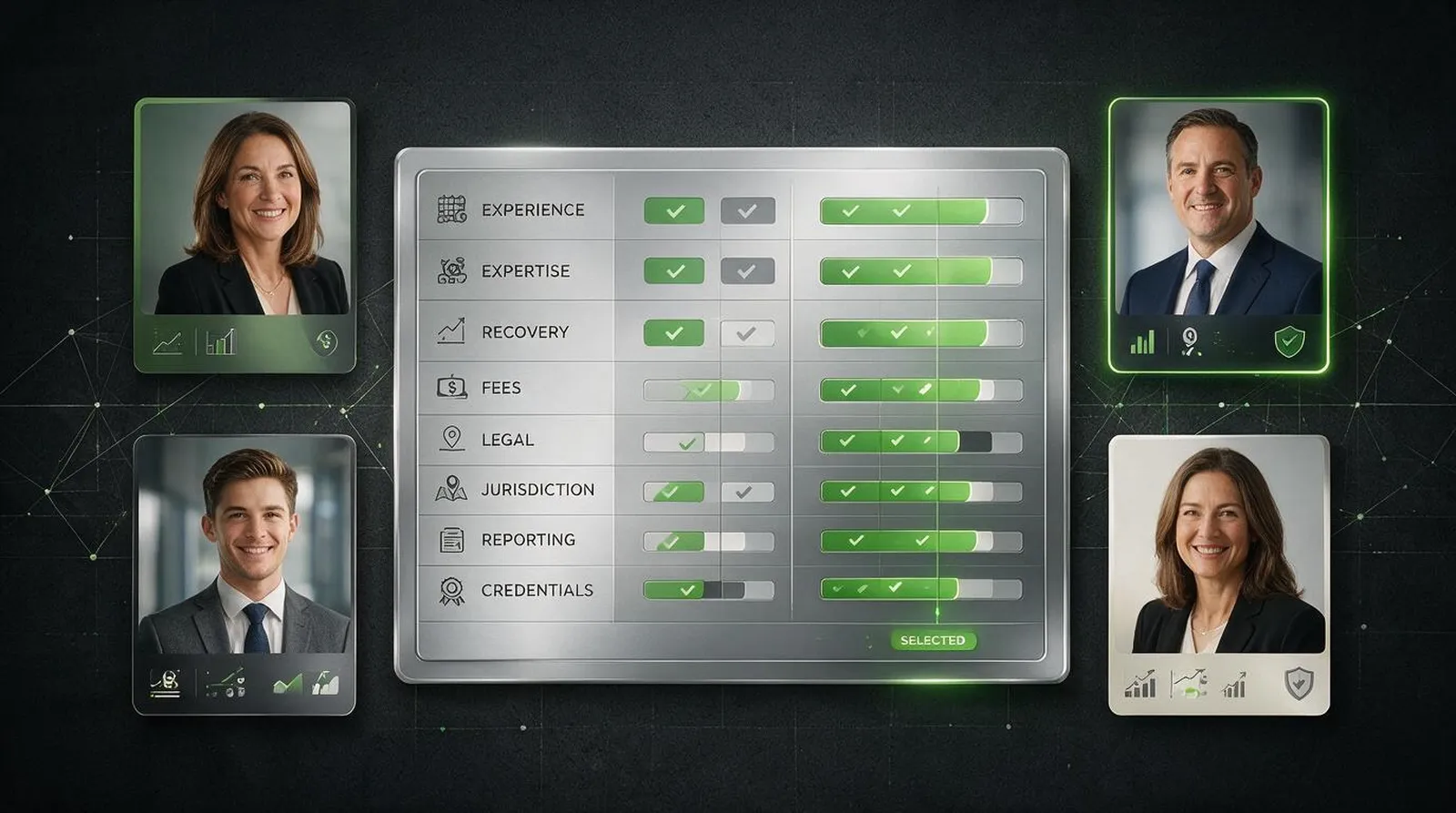
Compare commercial collection agencies and attorneys by costs, credentials, strategy, reporting, security, and fit before choosing a recovery partner.
Choose a commercial collection agency when the debt is documented, the goal is voluntary payment, and you want scalable outreach without filing suit. Choose a collection attorney when litigation, an immediate legal deadline, an injunction, a lien, complex contract defenses, or substantial asset risk makes legal strategy central. The best commercial collection service is licensed where required, experienced with your debtor type and claim size, transparent about fees and remittances, secure with your data, and disciplined about reporting, disputes, and attorney escalation. No provider is best for every account, and a law firm is not automatically the best first step. Next, prepare a short claim summary, compare two or three providers against the same scorecard, verify credentials, review the contract, and require a written recommendation for the first 30 to 60 days.
What is the difference between a collection agency and a collection attorney
A commercial collection agency pursues debts owed by businesses through letters, calls, email, account research, negotiation, and payment-plan administration. It does not file a lawsuit or give the creditor legal advice. Some agencies maintain attorney networks and can recommend a legal referral, but the creditor should understand when the file leaves the agency and who controls the next stage.
A collection attorney or collection law firm can evaluate legal claims, advise on venue and remedies, file suit, conduct discovery, seek judgment, and pursue lawful post-judgment enforcement. A lawyer may also make pre-suit demands and negotiate. The added authority can be useful, but litigation introduces court costs, deadlines, management time, evidentiary demands, counterclaim risk, and uncertainty about collectability.
Toro Recovery’s definitions of collection agency and legal collections explain the operational distinction. The right choice depends on the account, not the label on the provider.
When should you choose a commercial collection agency
An agency is usually the practical first choice when the claim is supported, the debtor is operating, and voluntary payment remains realistic. It is especially useful for a portfolio of accounts that needs consistent contacts, status tracking, and negotiated resolutions. The creditor can preserve the business relationship while moving collection activity outside the sales or accounts-receivable team.
The debtor acknowledges the obligation but is slow, disorganized, or short on cash
The claim value does not yet justify litigation cost and management time
Several accounts need standardized outreach and consolidated reporting
The creditor wants a contingency structure tied to amounts recovered
There is time to attempt pre-legal recovery without endangering a deadline
Agency placement should not become indefinite. Set review points for response, payment-plan performance, dispute quality, debtor location, and asset concerns. If the agency cannot develop meaningful contact or the debtor raises a material legal defense, require a documented recommendation to continue, settle, close, or refer.
When should you choose a collection attorney
Use an attorney early when the legal decision cannot safely wait. Examples include an approaching limitation period, a contractual notice deadline, bankruptcy, pending dissolution, fraud allegations, a request for emergency relief, a lien or bond claim, a large contested balance, or a debtor moving assets. Counsel should also review claims involving unusual damages, complicated ownership, competing venue clauses, or credible counterclaims.
A demand on law-firm letterhead does not by itself make litigation economical. Ask counsel to separate legal merit from collection likelihood. A strong complaint against an insolvent debtor can still produce a poor commercial result. Before authorizing suit, request a budget, venue analysis, expected timeline, service plan, known defenses, asset information, settlement range, and decision points for additional spending.
How do you decide between the two options
Decision factor | Commercial collection agency | Collection attorney |
|---|---|---|
Primary objective | Voluntary recovery and negotiated payment | Legal advice, suit, judgment, or formal remedy |
Best fit | Supported, collectible claim with no urgent legal event | High-value, disputed, deadline-driven, or remedy-dependent claim |
Typical economics | Often contingency-based; terms vary | Contingency, hourly, fixed, or hybrid, plus possible court costs |
Scale | Efficient for multiple accounts and recurring placements | Usually selected claim by claim |
Key risk | Delay without a firm escalation rule | Spending on a judgment that may be difficult to enforce |
Creditor decision | Set settlement and legal-referral authority | Approve pleadings, budget, settlement, and enforcement steps |
Use the business debt recovery calculator to test recovery, timing, and cost assumptions. The result is a planning estimate, not a prediction, but it helps compare a lower-cost voluntary strategy with immediate legal spending.
What should you ask about industry and claim experience
Ask for experience with your transaction, debtor type, balance range, and geography. A construction change-order dispute differs from an undisputed software subscription, staffing invoice, freight charge, or wholesale account. The provider should explain the documents it expects, common defenses, appropriate contact strategy, and circumstances that trigger attorney review.
Do not rely on a broad recovery-rate claim without definitions. Ask whether the denominator includes every placed account, only worked accounts, or accounts that met minimum documentation standards. Request results by age, balance band, dispute status, and industry when available. Ask how client withdrawals, bankruptcies, closures, duplicate placements, and uncollectible accounts affect the calculation.
References are most useful when they resemble your program. Ask a reference about onboarding, communication, remittance timing, reporting accuracy, dispute handling, complaint response, turnover, and how the provider behaves when a file is difficult. Do not ask for confidential debtor details.
How should you evaluate licensing and legal credentials
There is no single national license that answers every commercial-collection question. State and local rules differ, exemptions vary, and some regimes focus on consumer debt. Ask the provider for a jurisdiction-by-jurisdiction explanation of the authority it relies on for your placements. Verify the exact legal entity named in your contract, not a similar trade name.
California illustrates why scope matters: the Department of Financial Protection and Innovation describes its Debt Collection Licensing Act program and links to NMLS Consumer Access for licensed debt collectors, while its published definition centers on consumer debt. [1] [2] A business creditor should not assume that one consumer-debt license, registration, or exemption resolves every commercial requirement elsewhere.
For a law firm, verify each responsible lawyer with the licensing authority in the relevant state. The State Bar of California, for example, provides an Attorney Search and public information about discipline. [3] Confirm good standing, office location, responsible attorney, conflicts process, professional-liability coverage, and authority to appear in the expected court. A directory listing is a starting point, not a quality rating.
What fees and contract terms should you compare
Request a complete written fee schedule. Agency contingency rates may vary by account age, balance, volume, dispute status, location, prior placement, and whether counsel becomes involved. Attorney fees may be contingency, hourly, fixed, or hybrid. Court filing, service, local counsel, investigation, searches, transcripts, and enforcement can be separate costs.
A contingency fee ties compensation to recovery, but the percentage does not reveal the total economics. Compare the provider’s authority to settle, treatment of direct payments, fees after withdrawal, cost advances, minimum charges, remittance timing, taxes, interest allocation, and whether fees change after legal referral.
Read the agreement for term, renewal, termination, exclusivity, account recalls, audit rights, confidentiality, data return or deletion, subcontractors, complaint handling, indemnity, limitation of liability, insurance, governing law, and dispute resolution. Clarify who owns debtor communications and work product, who can authorize counsel, and whether the agency receives a fee on money paid directly to the creditor.
How should you assess communication and reporting
Require a named client contact, service expectations, and an escalation route. A useful report shows placements, contacts, disputes, promises, payments, broken promises, recommendations, closures, remittances, and legal referrals. The creditor should be able to reconcile each recovery to the debtor, invoice, fee, and remittance date.
During a demonstration, ask the provider to walk through a disputed account, a payment plan, a direct payment, a bankruptcy, and an attorney referral. Confirm how frequently notes update, whether reports can be exported, and how errors are corrected. A glossy dashboard matters less than complete, timely, explainable data.
What security and privacy questions should you ask
A collection provider may receive contracts, invoices, tax forms, bank information, contact data, and sensitive correspondence. Ask what data is required, how it is transmitted, where it is stored, who can access it, how access is reviewed, whether encryption and multifactor authentication are used, and how incidents are reported. Review retention, deletion, backup, subcontractor, and offboarding practices.
NIST’s Cybersecurity Framework 2.0 is designed to help organizations understand and reduce cybersecurity risk and includes governance and supply-chain considerations. [4] It does not certify a collection provider. Use it as a structure for questions, then evaluate independent reports, testing, policies, insurance, and contract commitments in proportion to the data and risk.
How should disputed debts and legal referrals be handled
Ask the provider to define a dispute, record the debtor’s position, pause any activity that should not continue, request the necessary documents, and give the creditor a deadline to respond. The provider should distinguish an administrative problem from a substantive contract defense and should not overstate facts, fees, litigation intent, or legal consequences.
For attorney referral, require a written handoff standard. Identify who selects counsel, checks conflicts, approves costs, reviews pleadings, controls settlement, receives status reports, and decides whether to pursue judgment enforcement. Confirm whether the agency remains involved and how fees are divided or changed.
The timing guide How Long Should You Wait Before Sending an Unpaid Invoice to Collections can help set the initial placement date and escalation checkpoints. A deadline or credible asset risk may justify faster legal review.
What does a practical selection process look like
Assume a distributor has 35 delinquent accounts totaling $410,000. Most debtors ordered repeatedly, received goods, and simply stopped following payment plans. Three accounts are disputed, and one large debtor appears to be closing locations. The creditor sends the same anonymized portfolio profile and contract questionnaire to three providers.
The creditor chooses an agency for the ordinary accounts because its workflow, reporting, documentation standards, and escalation rules fit the portfolio. It sends the disputed claims to counsel for legal assessment and asks for immediate review of the closing debtor. The choice is segmented by risk. It does not force every balance into one channel merely because one vendor quoted the lowest percentage.
Before placement, the creditor checks federal court records and other appropriate sources for bankruptcy or litigation information. The PACER Case Locator is the federal judiciary’s nationwide index for federal court cases, subject to its access and fee rules. [5] State court, corporate, lien, and asset research may require other sources and professional judgment.
What should a commercial collection service scorecard include
Category | Evidence to request | Warning sign |
|---|---|---|
Fit | Similar industries, balances, disputes, and locations | Generic claims with no comparable examples |
Credentials | Entity identity, applicable licenses, attorney standing, insurance | Evasive or incomplete credential answers |
Economics | Full fee schedule, costs, direct-payment and referral terms | Low headline rate with unclear additions |
Process | Contact plan, dispute workflow, escalation rules, authority limits | No defined review or legal handoff |
Reporting | Sample report, note timing, remittance reconciliation | Totals that cannot be traced to accounts |
Security | Access controls, encryption, incident terms, retention, vendors | Requests for unnecessary data or insecure transfer |
Weight the scorecard for your portfolio. A creditor with recurring small balances may emphasize automation, reporting, and cost. A creditor with several large engineering disputes may emphasize document analysis, attorney depth, venue coverage, and budget control. Record the basis for the selection and schedule a performance review after the first group of placements.
What should you check before signing
The contracting entity and responsible people have been verified
Applicable licensing, registration, exemptions, and attorney standing are documented
Fees, costs, direct payments, withdrawals, settlements, and legal referrals are clear
The provider’s authority limits match your approval process
Reporting, remittance, reconciliation, complaint, and audit procedures are written
Security, retention, incident, subcontractor, and offboarding terms are acceptable
The initial account strategy and 30-to-60-day review points are documented
Frequently asked questions
Is a collection agency cheaper than a collection attorney
Often, but not always. Agencies commonly use contingency fees; law firms may use contingency, hourly, fixed, or hybrid terms. Compare total fees, court costs, internal time, expected recovery, and collectability.
Should every old invoice go directly to an attorney
No. Age increases urgency but does not make litigation the best first step. Use counsel for deadlines, large disputes, asset risk, or legal remedies. A supported account may be better suited to agency recovery.
Can a collection agency sue a debtor
A collection agency does not act as the creditor’s courtroom lawyer. A licensed attorney must evaluate and file litigation. Ask which firm handles referrals and what approval and cost terms apply.
What recovery rate should a good provider promise
Treat guaranteed claims cautiously. Results depend on age, documentation, disputes, debtor condition, geography, balance, and placement history. Ask how comparable performance data was calculated.
How many providers should a business compare
Two or three serious candidates are usually enough. Give each the same portfolio profile and questions, then compare them against defined decision criteria.
Should the creditor choose the lowest contingency fee
Not by itself. A lower fee may cost more if contact, remittances, reporting, or legal referrals are weak. Compare expected net recovery, controls, fit, service, and contract terms.
How can Toro Recovery help you choose the next step
Start with a clear account profile: balance, age, contract, performance evidence, dispute, debtor status, deadlines, and desired outcome. Toro Recovery can identify documentation gaps and discuss whether commercial collection activity or attorney review is the more proportionate next step. Legal decisions remain with the creditor and qualified counsel.
For a fuller view of the process, read the B2B debt collection guide. If the account is still in final-demand status, the collection letter generator can help organize the notice before placement.
This article provides general business information, not legal advice. Licensing, collection communications, evidence, limitation periods, court procedure, fees, privacy, and professional obligations vary by jurisdiction and circumstance.
Sources and references
1. California Department of Financial Protection and Innovation, Debt Collectors
2. Nationwide Multistate Licensing System, NMLS Consumer Access
3. State Bar of California, Attorney Search
4. National Institute of Standards and Technology, Cybersecurity Framework
5. Administrative Office of the U.S. Courts, PACER Case Locator