
TORO Recovery Blog
How to Write a Demand Letter for an Unpaid Business Invoice.
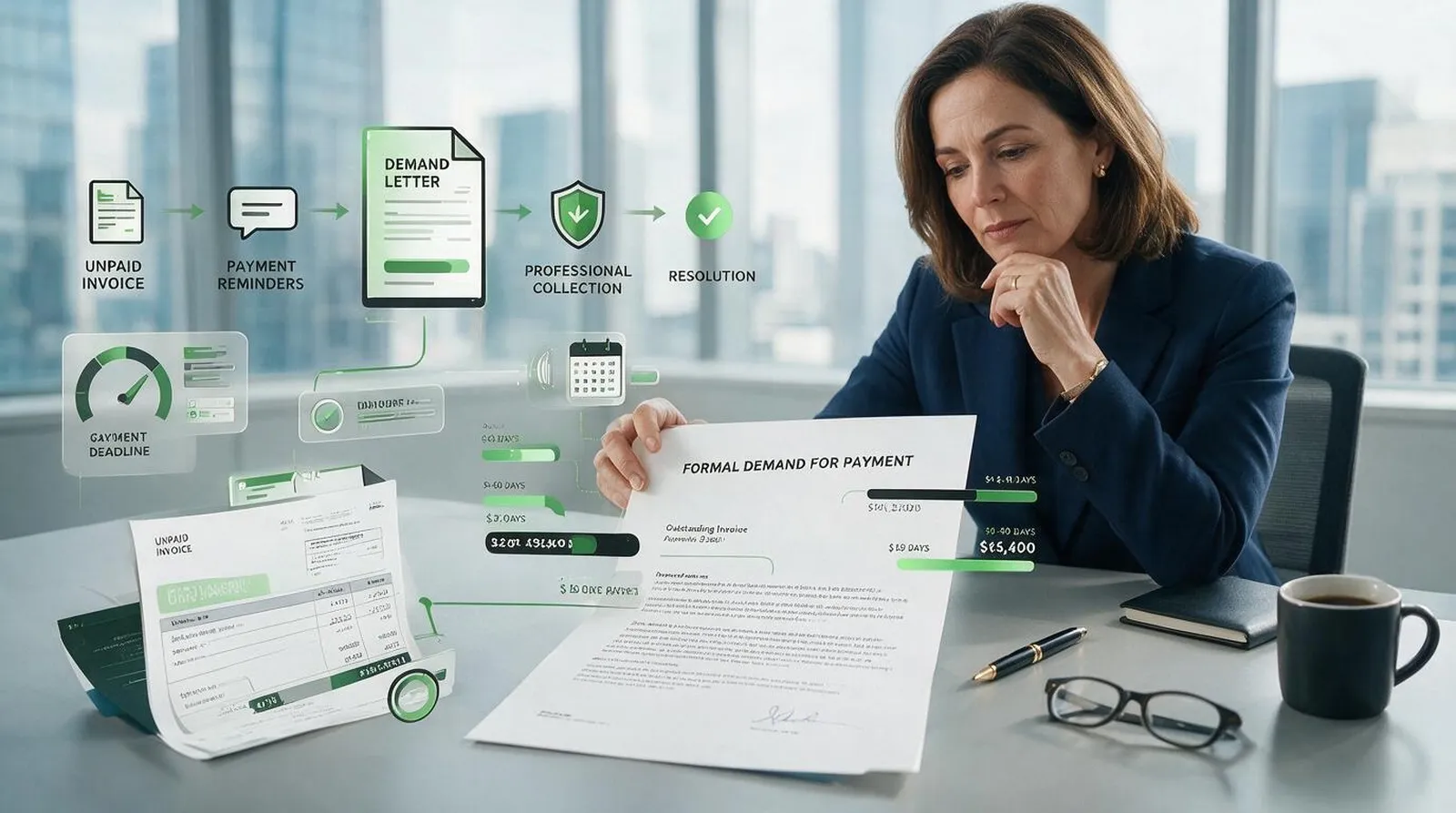
Learn how to write a clear demand letter for an unpaid business invoice, set a deadline, document the debt, and choose the right next step with care.
A demand letter for an unpaid business invoice should identify the parties and invoice, state the exact balance, explain why payment is due, set a firm deadline, provide payment instructions, and describe the next step if the account remains unpaid. Attach or reference the contract, purchase order, invoice, delivery record, and account statement. Keep the tone factual and do not threaten a lawsuit, collection action, interest, or fees unless the contract and applicable law support that step. Requirements vary by contract, claim, and state, and bankruptcy may halt collection entirely. Before sending the letter, verify the debtor’s legal name and address, reconcile the balance, review notice and cure provisions, and check for disputes or bankruptcy. If the deadline expires without a workable response, decide promptly whether to negotiate, place the account with a commercial collection partner, or consult counsel.
What is a demand letter for an unpaid invoice
A demand letter is a formal written request for payment of a specific obligation. For a business invoice, it usually follows ordinary reminders and precedes outside collection or litigation. Its purpose is to give the customer a final, organized opportunity to pay or raise a genuine dispute while creating a dated record of the creditor’s position.
A strong letter is more than an overdue notice. It connects the balance to the governing agreement and performance evidence, tells the recipient exactly how to resolve the account, and establishes a reasonable response date. Some contracts and court procedures require a particular notice or demand before a remedy is available. For example, California’s small-claims guidance tells a prospective plaintiff to ask the other side for the money before filing. That example is not a national rule; it illustrates why the governing contract and forum must be checked before escalation. [1]
When should a business send a demand letter
Send a demand letter after the invoice is clearly past due, routine reminders have failed, and the file is accurate enough to support escalation. The right timing depends on the payment terms, customer history, size of the balance, quality of the evidence, and any contractual notice period. A letter sent too early can disrupt a relationship or bypass an agreed cure process. A letter sent too late can allow evidence to deteriorate and a limitation period to approach.
Account condition | Recommended action | Why |
|---|---|---|
Invoice recently due; customer usually pays | Confirm receipt and send a courteous reminder | The problem may be administrative rather than a refusal to pay |
Repeated promises or unanswered reminders | Prepare a formal demand with a defined deadline | A clear escalation point can prompt a decision |
Quality, quantity, delivery, or pricing dispute | Investigate and answer the dispute before demanding the full amount | Ignoring a documented defense weakens credibility |
Contract requires notice and an opportunity to cure | Follow the required method, address, content, and cure period | Noncompliant notice may impair a contractual remedy |
Bankruptcy filing identified | Stop ordinary collection and consult bankruptcy counsel | The automatic stay may prohibit collection activity |
Deadline to sue may be near | Escalate immediately to qualified counsel | A letter generally should not be assumed to extend the filing period |
Do not use a fixed aging rule as a substitute for judgment. A 30-day balance with a broken promise may deserve faster action than a 90-day balance covered by an agreed payment plan. Toro Recovery’s overview of B2B debt collection explains how account age, documentation, disputes, and collectability affect escalation.
What should you verify before writing
Treat the file review as the foundation of the letter. Start by confirming the debtor’s exact legal identity, any trade name, the billing and notice addresses, and the person responsible for accounts payable. Confirm which entity ordered the work and whether a guarantor signed. Sending a demand to the wrong affiliate or naming a guarantor who never agreed to liability can create avoidable disputes.
Assemble and reconcile the documents that prove the transaction:
The signed contract, credit application, purchase order, proposal, or accepted terms.
The invoice and an account statement showing charges, credits, payments, and the remaining balance.
Proof of delivery, time records, completion certificates, acceptance emails, or other performance evidence.
Prior reminders, promises to pay, dispute correspondence, and any proposed settlement or payment plan.
Contract provisions covering payment dates, notice, cure, interest, late charges, collection costs, attorney fees, governing law, forum, arbitration, and personal guarantees.
Recalculate the demand from source records. Separate principal, contractual interest, late charges, credits, taxes, and other amounts. Do not add collection costs or attorney fees merely because the account is overdue. The agreement and applicable law must support each component. If the customer has asserted a setoff, warranty claim, short shipment, or service deficiency, summarize the issue and the business’s response rather than pretending the dispute does not exist.
What should an unpaid invoice demand letter include
The reader should be able to understand the claim and act without searching through an email chain. Use a descriptive subject line, short paragraphs, and an itemized balance.
Letter element | What to state | Practical purpose |
|---|---|---|
Parties and account | Creditor, debtor, account number, and the correct legal names | Connects the demand to the responsible entities |
Basis of obligation | Agreement, purchase order, goods, or services and relevant dates | Explains why payment is owed |
Invoice details | Invoice number, issue date, due date, original amount, credits, and balance | Makes the amount auditable |
Prior activity | Key reminders, acknowledgments, promises, and dispute responses | Shows the account history without retelling every contact |
Demand and deadline | Exact amount requested and a calendar date for receipt or response | Removes ambiguity |
Payment and contact | Approved payment method and a named contact for a documented dispute | Gives the recipient a clear path to resolution |
Next step | A truthful, authorized statement about collection review, counsel, or available remedies | Explains the consequence without bluffing |
Attachments | Copies of the invoice, statement, agreement excerpts, and key proof | Supports review while preserving originals |
How firm should the language be
Use a professional, controlled tone. State facts in chronological order, distinguish confirmed amounts from disputed amounts, and ask for one concrete action. A demand becomes less persuasive when it uses insults, exaggerated consequences, or vague accusations of fraud. It also creates risk when it claims that suit, criminal referral, credit reporting, a lien, or asset seizure is inevitable.
Only describe a consequence that the business has authorized and could lawfully pursue. If litigation has not been approved, say the account may be referred for further collection or legal review. Do not identify the sender as an attorney or imply attorney involvement unless that is true. Do not state that a fee is recoverable until the contract and governing law have been reviewed. Accuracy is both a legal safeguard and a negotiation advantage.
Federal consumer collection law generally focuses on obligations incurred primarily for personal, family, or household purposes. The statutory definition of “debt” reflects that purpose test, and the FTC and CFPB state that the FDCPA does not cover business debts. That does not make commercial collection unregulated. State collection-agency laws, licensing rules, contract law, unfair or deceptive practices laws, court rules, bankruptcy law, and professional-conduct rules may still apply. Classification becomes especially important when a sole proprietor, individual guarantor, or mixed-use transaction is involved. [2] [3] [4]
How much time should the letter give the customer
Use the deadline required by the contract or applicable law. When no specific period applies, 7 to 14 calendar days is a common business working range, but it is not a universal legal standard. Choose enough time for delivery, internal review, and payment while avoiding an open-ended request. State a specific date rather than “within ten days,” which can invite disagreement about when the clock began.
If the account is complicated, ask for payment or a written response by the deadline. That wording leaves room for a documented dispute or realistic payment proposal without weakening the demand. A very short deadline may look unreasonable; a long deadline may waste valuable time. Never let a demand-letter response date distract from a limitation period. Under the model UCC rule for contracts for the sale of goods, an action generally must be commenced within four years after accrual, subject to the parties’ permitted reduction and each state’s enacted version. Service contracts and other claims may use different periods. [5]
How should you send and document the demand
Follow the contract’s notice clause first. It may specify a physical address, recipient, delivery service, email address, or when notice becomes effective. If the clause requires more than one method, use each method. Otherwise, a practical approach is to send the letter by a trackable physical method and, when appropriate, email a PDF copy to the established business contact. Certified mail is useful evidence, but it is not required for every demand and a refused certified letter can delay actual notice.
Keep the final letter, attachments, delivery record, email record, and any response. Preserve original evidence and record later calls. A clean chronology helps an agency or attorney assess the claim.
What does a practical demand letter look like
Replace every bracketed item and remove any remedy the business has not approved.
[Date]
Via [contractually required method] and email
[Debtor’s exact legal name and address]
Re: Final demand for Invoice [number], account [number]
Dear [name]:
[Creditor’s legal name] provided [goods or services] under [contract or purchase order] dated [date]. Invoice [number] was issued on [date] for $[original amount] and became due on [date]. After applying payments and credits of $[amount], the outstanding principal balance is $[balance]. A current statement and copies of the supporting documents are enclosed.
We previously requested payment on [dates]. On [date], [briefly state any acknowledgment, promise, or dispute and the creditor’s response]. Our records show that $[total amount demanded] remains due, consisting of $[principal] plus $[interest or fees only if supported, with calculation].
Please ensure that cleared funds in the amount of $[amount] are received no later than [specific calendar date]. Payment may be made by [approved instructions]. If you dispute any part of the balance, send a written explanation and supporting documents to [contact information] by the same date.
If payment or a substantive written response is not received by that date, [creditor] may refer the account for commercial collection or legal review and evaluate the remedies available under the agreement and applicable law. Nothing in this letter waives any rights or remedies.
Sincerely,
[Authorized sender, title, company, and contact information]
Enclosures: [invoice, statement, agreement excerpt, proof of performance]
The example deliberately avoids claiming that litigation will occur. If counsel has approved a specific pre-suit demand, use counsel’s language and instructions. Toro Recovery also provides a collection letter generator for businesses that need a structured starting point.
What should you do after sending the letter
Calendar the delivery date, response deadline, limitation date, and any contractual cure milestone. Then route the response based on what the customer actually does. Avoid restarting a cycle of vague reminders after a final deadline.
Customer response | Immediate next step | Decision point |
|---|---|---|
Pays in full | Confirm cleared funds and close the account | Release only what the agreement or law requires |
Proposes a payment plan | Verify finances, dates, method, default terms, and authority | Use a signed written agreement if the plan is accepted |
Raises a documented dispute | Pause assumptions and review the evidence with operations or counsel | Correct the balance, negotiate, or prepare a supported rebuttal |
Promises payment without specifics | Require an amount and date in writing | Escalate if the promise is missed |
Does not respond | Assess collectability and refer the file promptly | Compare collection, litigation, settlement, and write-off economics |
Reports bankruptcy | Stop ordinary contact and verify the case | Consult bankruptcy counsel about the stay and proof of claim |
A bankruptcy petition generally triggers an automatic stay against efforts to recover a prepetition claim, subject to statutory exceptions. Do not send another ordinary demand merely because the invoice is valid. Verify the filing and obtain advice on the proper bankruptcy process. [6]
When should the account go to collections or counsel
Consider commercial collection when the balance is supported, ordinary outreach has failed, and the customer appears reachable or collectible. Consider counsel earlier when the amount is substantial, a limitation period is close, the debtor has asserted legal defenses, the contract requires arbitration, collateral or lien rights may exist, multiple states are involved, or emergency relief may be needed. A collection agency and an attorney serve different functions, and the economics should be compared before the file ages further.
A referral package should include the demand letter, contract, invoices, account ledger, performance evidence, communications, dispute history, debtor and guarantor information, and known asset or bankruptcy facts. The cleaner the package, the faster an outside professional can evaluate liability and collectability. Use Toro Recovery’s business debt recovery calculator to frame the economic decision, then contact Toro Recovery if the account is ready for a professional recovery review.
Frequently asked questions
Is a demand letter legally required before suing over an invoice
Sometimes. A contract, statute, court rule, or claim type may require notice or an opportunity to cure. Even when no formal demand is required, a written request can support settlement and preserve a useful record. Check the governing agreement, jurisdiction, forum, and filing deadline.
Can I write the demand letter myself
A business can often send its own factual payment demand. Counsel should review higher-value, disputed, multi-state, secured, regulated, or time-sensitive claims, and any letter that threatens a specific lawsuit or specialized remedy.
Can I charge interest or late fees
Only demand amounts supported by the agreement and applicable law. Identify the rate, period, and calculation instead of presenting an unexplained total. State law may restrict rates, fees, compounding, or recovery even in commercial transactions.
Should I send the letter by certified mail
Certified or another trackable method can help establish delivery, but it is not universally required. Follow the contract’s notice provision and applicable law. When appropriate, send an email copy as well so the intended business contact receives the demand promptly.
Does a demand letter stop the statute of limitations
Do not assume so. Sending a letter generally is not the same as filing an action, and tolling or revival rules vary. If a deadline may be close, consult counsel immediately rather than waiting for the demand period to expire.
What if the customer disputes only part of the invoice
Separate the undisputed and disputed amounts, request payment of the undisputed balance, and investigate the rest. Review contract rights before accepting partial payment or stating that it resolves the account.
How many demand letters should I send
One well-supported final demand is often more effective than repeated letters with shifting deadlines. Send another only when new information, a negotiated extension, or a contractual requirement justifies it.
What is the next step for an unpaid business invoice
Review the contract and file, calculate the balance, and send a concise demand to the correct business and notice address. Set a payment or response date, preserve delivery evidence, and calendar follow-up. If the deadline passes, decide whether to negotiate, use commercial collection, consult counsel, or write off the account. A prompt handoff gives the next professional better evidence.
For a broader process—from classifying the debt through recovery and litigation review—read Toro Recovery’s B2B Debt Collection guide. This article provides general information, not legal advice. Laws and contract requirements vary, and a qualified attorney should review questions about rights, deadlines, remedies, or disputed liability.
Sources and references
[1] California Courts, Ask for the Money. Example of a court system requiring a pre-filing request for payment in its small-claims process.
[2] 15 U.S.C. § 1692a. Federal statutory definitions, including the personal, family, or household purpose test.
[3] Federal Trade Commission, Debt Collection FAQs. FTC consumer guidance stating that business debts are not covered by the FDCPA.
[4] Consumer Financial Protection Bureau, What Laws Limit What Debt Collectors Can Say or Do. CFPB explanation of the FDCPA’s general scope and state-law overlay.
[5] Uniform Commercial Code § 2-725. Model limitation rule for contracts for the sale of goods; enacted state versions may vary.
[6] 11 U.S.C. § 362. Federal bankruptcy automatic-stay provisions.